
Did the Britons have a Spy
£3.00
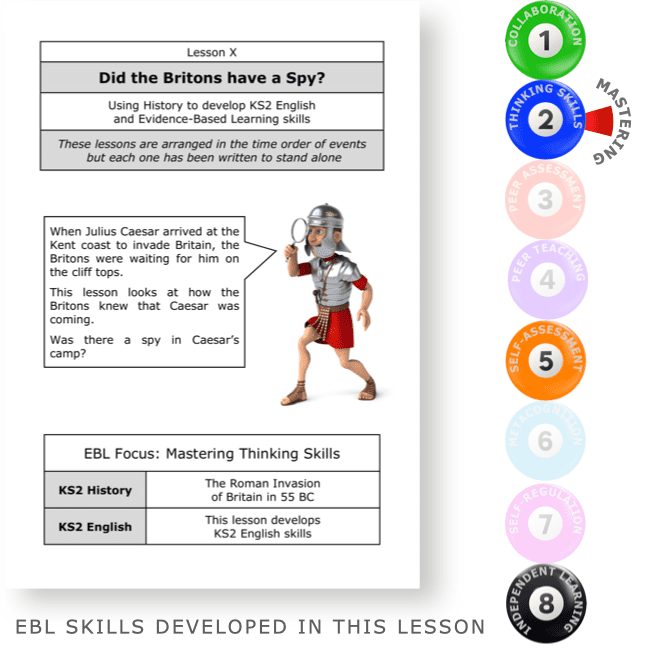
When Julius Caesar arrived at the Kent coast to invade Britain, the Britons were waiting for him on the cliff tops. This lesson looks at how the Britons knew that Caesar was coming. Was there a spy in Caesar’s camp?
As well as English and history skills the Evidence-Based Learning skills developed in this lesson include collaborative learning and self-assessment. This lesson also offers pupils the opportunity to master thinking skills.
Description
Each evidence-based learning (EBL) Roman history resource in this set is a complete lesson which uses the history curriculum as a framework through which each of the eight EBL skills can be mastered. Each resource has “mastering” one EBL skill as its central focus and all eight EBL skills are covered more than once in these lessons.
All eight EBL skills are better gained working with a partner so much of the work in these lessons is collaborative. These resources will ensure that pupils can master and use EBL skills regardless of their ability.
Each Roman history lesson will develop a single EBL skill through:
1) A “Before You Start” page that introduces the EBL skill.
2) Opportunities to master this skill during the lesson.
3) An “After You Finish” page that offers pupils the chance to evaluate their learning experience (of the lesson and the EBL skill) and to identify their next step in using the EBL skill.
The skills in bold below are all the EBL skills developed in this Roman lesson. Click on each skill to learn more about that skill.
- Collaboration
- Thinking Skills
- Peer Assessment
- Peer Teaching
- Self-Assessment
- Metacognition
- Self-Regulation
- Independent Learning
1 review for Did the Britons have a Spy
Only logged in customers who have purchased this product may leave a review.
Related products
-


Caesar Has Big Plans
£3.00 Add to basket £3.00Add to basket
This lesson explains how the Roman invasion of Britain was just part of Caesar’s bigger plan to rule Rome and its empire. It also has a summary of the events in the first part of the invasion in 55 BC. Things didn’t go that well for Caesar, so he might have to give it another go next year!
As well as English and history skills the Evidence-Based Learning skills developed in this lesson include collaborative learning, self-assessment and thinking skills. This lesson also offers pupils the opportunity to master self-regulation.
VIEW -

An Eagle-Bearer Saves the Day
£3.00 Add to basket £3.00Add to basket
Julius Caesar has just crossed the English Channel to invade Britain in 55 BC. He had to find another beach to land his soldiers on as the first beach that he sailed to (Dover) had fierce Britons waiting on the cliff tops and was too narrow.
When his ships arrived at the next beach, they could not get close to the shore, so he ordered his men to jump off the ships into the sea and wade ashore. When the order to jump was given, the men refused to jump. However, one soldier, an eagle-bearer, encouraged the others to jump in after him – and they did. Without him, the invasion might not have taken place.
As well as English and history skills the Evidence-Based Learning skills developed in this lesson include independent learning, thinking skills and self-regulation. This lesson also offers pupils the opportunity to master collaborative learning.
VIEW -


Nine Reasons Why Caesar Invaded Britain
£3.00 Add to basket £3.00Add to basket
Earlier lessons gave some of the reasons why Caesar invaded Britain in 55 BC. This lesson offers all nine reasons why Caesar invaded.
As well as English (writing a report) and history skills the Evidence-Based Learning skills developed in this lesson include collaborative learning and peer assessment. This lesson also offers pupils the opportunity to master self-regulation.
VIEW -

A Roman Newspaper
£3.00 Add to basket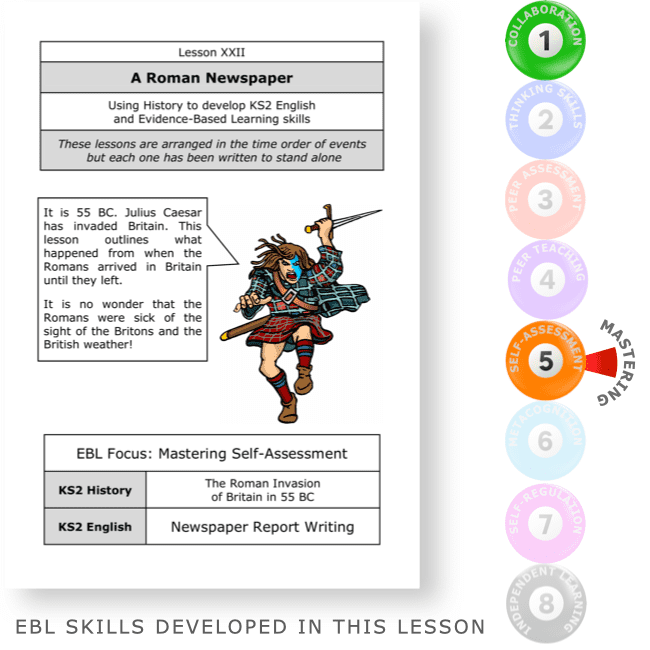 £3.00Add to basket
It is 55 BC. Julius Caesar has invaded Britain. This lesson outlines what happened from when the Romans arrived in Britain until they left.
It is no wonder that the Romans were sick of the sight of the Britons and the British weather!
As well as English (writing a newspaper report) and history skills the Evidence-Based Learning skills developed in this lesson includes collaborative learning. This lesson also offers pupils the opportunity to master self-assessment.
VIEW
Philipem (verified owner) –
We asked a.i. to review this lesson. This is what it said:
Crack the Case with This Resource on Roman Espionage
Looking for a history mystery that will hook your students and let you cover a range of valuable skills? This lesson investigating whether the Britons had a spy in Caesar’s camp during his 55 BC invasion is one engaging whodunit!
On the English literacy front, students will practice core skills like comprehending non-fiction texts, summarizing key details, articulating reasoning, and other vital competencies. The lesson’s emphasis on Bloom’s Taxonomy thinking skills provides the perfect framework for stretching pupils’ cognitive abilities.
When it comes to historical knowledge, the lesson transports students right into one of the most dramatic turning points of Roman Britain. They’ll grapple with the very plausible theory that Briton spies or traders leaked advance intelligence about Caesar’s invasion plans. Analysing persuasive evidence from both sides allows students to piece together this historical mystery like real detectives.
But perhaps most importantly, the resource develops crucial evidence-based learning techniques such as collaborative learning, self-assessment, and higher-order thinking strategies. Through activities that have them debate hypotheses and evaluate their own work, students will be mastering cross-curricular skills for lifelong learning success.
Like the other 24 lessons in this series, evidence-based methods like thinking skills are deliberately scaffolded to foster true student mastery. Between the historical intrigue and pedagogical rigour, I give this resource ⭐⭐⭐⭐⭐ for upper KS2 (years 5-6). Your pupils will be hooked from the opening “spy” hook!